

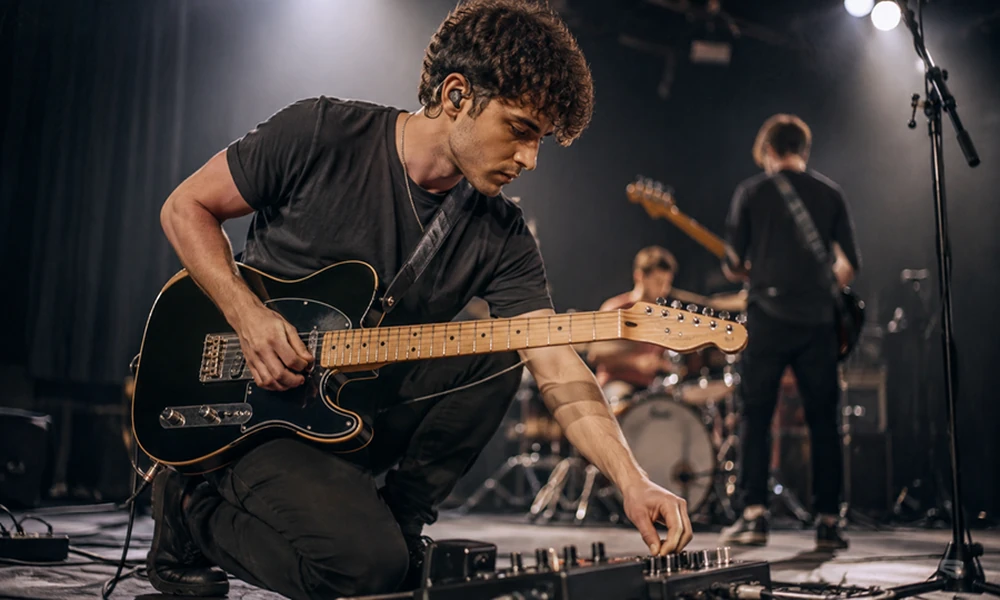
Learning scales, chords, riffs, and solos can make a guitarist technically stronger, but technical ability alone does not guarantee confidence on stage. Performance introduces challenges that rarely appear when practicing alone: keeping time with other musicians, responding to unexpected changes, controlling dynamics, recovering from mistakes, and communicating musically in real time.
For guitarists who want to become more complete players, practice should therefore extend beyond improving finger speed or memorizing increasingly difficult material. The following skills help bridge the gap between being able to play guitar and being prepared to perform music with others.
Build a Strong Internal Sense of Time
A guitarist can play every correct note and still make a performance feel unstable if the timing is inconsistent.
Rhythm should be treated as a fundamental musical skill rather than something left to the drummer. Practicing with a metronome is useful, but players can go further by changing where the click falls, slowing familiar exercises down, and practicing rhythm parts without relying on a recording.
It also helps to pay attention to subdivisions. Instead of simply knowing where each beat lands, listen for eighth notes, sixteenth notes, triplets, and the spaces between notes.
Strong time makes virtually everything else easier. A guitarist with reliable rhythm can support singers, lock in with a rhythm section, accompany another instrumentalist, or hold together a solo passage without rushing when the music becomes difficult.
Turn Practice Into Performance Preparation
Private practice often allows unlimited restarts. Live music does not.
One useful adjustment is to regularly play songs from beginning to end without stopping. If a mistake happens, continue playing and find a musical way back into the arrangement. This develops recovery skills and reveals weaknesses that repeatedly practicing isolated sections may hide.
Guitarists should also divide their development among several areas rather than concentrating entirely on technique. Ear training helps with recognizing musical relationships, theory provides a framework for understanding what is being played, reading can improve communication, and exposure to different styles increases adaptability.
For players considering more structured development, examining the curriculum of a guitar performance program can also provide a useful reference for how technique, ear training, theory, reading, stylistic study, and performance experience can fit into a broader approach to musicianship.
The objective is not simply to accumulate more exercises. It is to connect individual skills so they remain useful when music is actually being made.
Learn to Listen While You Play
Practicing alone can encourage guitarists to focus almost exclusively on their own sound. Ensemble playing demands the opposite.
A strong performer listens continuously.
That means noticing what the drummer is doing with the groove, where the bass is moving harmonically, how much space the vocalist needs, and whether another instrument already occupies the same frequency or rhythmic space.
This ability changes how a guitarist approaches both rhythm and lead playing. Instead of asking, “What can I add here?” the better question is often, “What does this section need?”
Listening also improves dynamics. Not every chorus needs more volume, and not every open space needs a guitar fill. Sometimes reducing what you play creates more impact than adding another layer.
Another essential skill is reacting to small changes without becoming distracted. A drummer may alter a fill, a singer may hold a phrase longer than expected, or another musician may cue an additional section. Musicians who actively listen can respond instead of remaining locked into a memorized sequence.
Develop Adaptability Instead of One-Dimensional Skill
Specializing in a musical style can help a guitarist develop a recognizable voice, but versatility provides another kind of advantage: the ability to enter unfamiliar musical situations and contribute quickly.
A practical way to build versatility is to study the underlying vocabulary of several styles. A guitarist does not need to become an expert in every genre. Instead, learn how rhythm, articulation, tone, phrasing, and harmony change from one musical context to another.
For example, playing fewer notes with accurate articulation may be more appropriate than applying a favorite lead technique everywhere. Likewise, understanding how to support a vocalist may be more valuable in some settings than demonstrating technical complexity.
Adaptability also includes equipment and sound. Players should know how their basic setup works well enough to make sensible adjustments without spending an entire rehearsal troubleshooting tone.
The goal is musical flexibility: being able to understand the situation, make useful decisions, and serve the song.
Conclusion
Becoming performance-ready requires a broader skill set than playing increasingly difficult guitar parts. Timing, listening, stylistic awareness, adaptability, musical understanding, recovery skills, and experience playing complete pieces all contribute to confidence on stage.
These abilities develop through deliberate practice, but they become meaningful when they are tested in real musical situations. Guitarists who regularly combine individual study with listening, collaboration, and performance preparation can turn isolated techniques into practical musicianship-and become players other musicians can rely on.